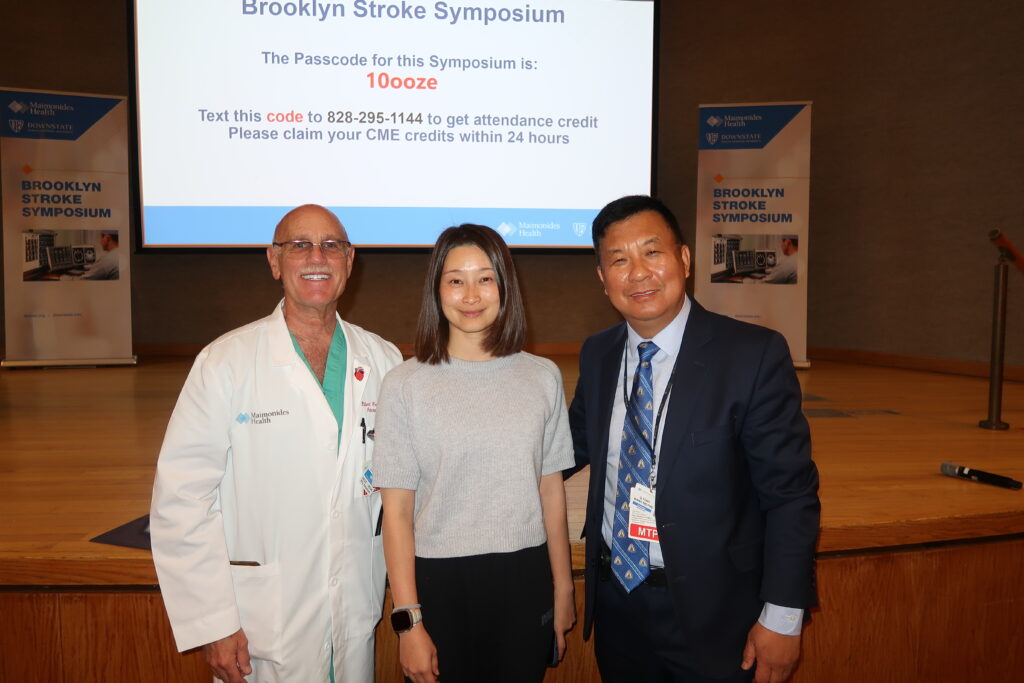
The Jaffe Comprehensive Stroke Center at Maimonides, Maimonides Neurosciences Institute, and SUNY Downstate Health Sciences University Department of Neurology held the 6th Annual Brooklyn Stroke Symposium on May 14, 2026, at Maimonides Medical Center. Nearly 1,100 professionals attended virtually and in person, bringing expert knowledge from national field leaders to stroke care teams from across the country and the world.
“This is a pivotal time for stroke care, with new therapies constantly emerging, and AI, robotics, and other cutting-edge technologies opening up so many possibilities in all areas of clinical care,” said Q. Tony Wang, MD, PhD, Director of the Jaffe Comprehensive Stroke Center and Vice Chair and Associate Professor of Clinical Neurology at SUNY Downstate Health Sciences University. “Under the main theme of innovations and entrepreneurship, this year’s symposium speakers comprised a diverse group of clinical and academic leaders, including world-renowned and local experts, who shared their experience and expertise to help attendees take a deeper dive and gain perspectives on the rapid changes underway in our field of stroke and neurovascular diseases.”
Advancing stroke diagnostics and care with AI
The first presentation of the day was “Acute Stroke Management in the AI Era,” presented by Chaitanya Medicheria, MD, Assistant Professor of Neurology at Maimonides Medical Center/SUNY Downstate. Dr. Medicheria reviewed the evolution of AI alongside the timeline of development for modern stroke care, and the ways in which AI has been integrated into clinical workflows to diagnose and treat stroke.
“The strength of AI is its ability to build logic and build a knowledge base, allowing it to, for example, recognize cerebral hemorrhage or through imaging, and differentiate it from a mass or MS lesion or other possible conditions, and determine whether a stroke is suspected,” he said. “Other specialized AI programs can also recognize large vessel occlusions, effacement of the ventricles, midline shift, edema, and other conditions.”
Dr. Medicheria discussed the strengths and challenges of AI use in stroke care. Volume dependency is one nuance; in many programs, a small hemorrhage might not be as well detected compared to a larger hemorrhage.
“Another key advantage of AI systems is the capacity to help improve radiology pipelines when it comes to stroke recognition,” he said. “For example, for patients who are not triaged as stroke cases, AI systems can recognize and alert care teams immediately when stroke signs present on CT scans or other diagnostics, even if radiologists have not yet reviewed imaging.”
Additionally, in the realm of imaging, AI can upscale and motion-correct MRI scans in real time, taking low-resolution images and artificially improving visibility of information and allowing for more accurate ultrafast MRI protocols for patients who may not be able to tolerate the length and demands of traditional MRI procedures. Systems can also integrate imaging and patient data to help predict aspect scores to identify early signs of stroke, rate of progression, edema progression, and other factors to predict hemorrhagic transformation risk.
Algorithm bias and questions of transparency and accountability, Dr. Medicheria said, all pose a risk to AI-influenced healthcare outcomes as technologies continue to develop.
“These systems are only as good as the data you feed them and the logical training that you give them, so we really have to be able to trust exactly how those building these tools are coming to these conclusions,” he said. “We must also keep in mind the need to stay vigilant as issues of accountability in AI-assisted medical treatment emerge. It may be years until we truly understand the impact these tools will have on the medical field. But overall, the opportunities to responsibly advance stroke care are very exciting.”
A roadmap to building national leadership, equity in stroke care
Adnan Siddiqui, MD, PhD, FAANS, FAHA, Distinguished Professor and Vice Chairman in the Department of Neurosurgery at the State University of New York at Buffalo’s Jacobs School of Medicine and Biomedical Sciences, CEO and CMO of the Jacobs Institute, and Director of the Canon Stroke and Vascular Research Center in Buffalo, New York, shared an overview of the development and progress of the Jacobs Institute and the Stroke Research Center at Gates Vascular Institute.
“In Western New York, the rate of stroke death is 79% higher than the New York State average and 23% higher than the national average, so outcomes are comparable to the U.S. stroke belt rather than the rest of our state,” Dr. Siddiqui said. “The need to innovate rather than just improve the care available was obvious.”
The Gates Vascular Institute was founded and supported by New York State and local institutional funds, with the long-term transformative vision of an integrated neurovascular institution combining the power of cutting-edge research driven by clinical needs and innovation at the bench with state-of-art clinical delivery at the bedside. It now treats more strokes than any other health system in New York State and is a national leader in developing new technologies for treating and preventing strokes, including more than 100 commercially available products and 40 medical devices approved by the FDA.
Dr. Siddiqui reviewed new innovations in stroke care currently being utilized at the institute and beyond, including alternatives to standard stent retrievers to avoid complications like extravasation; paired vagus nerve stimulation and rehabilitation services driving improved recovery outcomes; and AI-assisted robotic surgery to help improve accuracy of neurologic and neurosurgical outcomes and prognosis.
“Fifty percent of the population does not have timely access to adequate stroke care,” he said. “Robotics give us the potential to treat everyone at their first point of contact. The U.S. has more than 1,800 catheterization labs, which can be configured for robotic surgery and allow experts to carry out interventional procedures hundreds of miles away.”
Dr. Siddiqui detailed his participation in neurosurgical trials for the Symani microsurgical system, and discussed new devices to treat conditions ranging from aneurysms to hydrocephalus, as well as brain–computer interfaces to connect the brain directly to external devices, with applications for patients with severe paralysis and other conditions.
“We are seeing a new wave of innovation spanning robotics, a shift toward endovascular intervention, and even the emerging field of neuroendovascular electrophysiology,” he said. “This opens the door for so many new diagnostic and therapeutic applications for stroke and other neurologic and endovascular conditions, as well as more equitable stroke care.”
Mechanical clot densification and shrinkage: A novel endovascular approach
Dr. Siddiqui’s presentation touched upon new technologies to treat thrombosis, while Renee Zhao, PhD, Assistant Professor of Mechanical Engineering, BME, and MSE at Stanford University, went into further depth in her presentation—“Novel Thrombectomy Approach: Mini-Spinner Clot Buster Devices”—on strategies and engineering solutions of shrinking the clot involved in acute large vessel occlusion (LVO) cases, besides traditional thrombectomy advancement of making larger bore aspiration catheters, that may further revolutionize the already minimally invasive endovascular approaches.
With roughly one-third of global deaths caused by circulatory diseases, thrombosis is a key mechanism behind most of these deaths, with 85% of those circulatory disease deaths caused by clot- or blockage-related events, including stroke.
Conventional thrombectomy techniques, such as aspiration or stent retrievers, are effective stroke treatments, but depending on the size and composition of the clot, the process often requires use of multiple devices, making it costly, or can result in clot fragmentation or blood vessel injuries leading to complications.
“Increasing the size of the catheter can pose significant challenges, including vessel damage,” Dr. Zhao said. “So instead of approaching the problem by making the equipment larger, we can actually make the clot itself smaller and therefore easier to remove. With milli-spinner thrombectomy, we can reduce the clot volume by 95%, to less than 5% of its initial volume.”
This technology prevents fragmentation during removal procedures, and is highly effective, allowing the clot to be eliminated within a matter of seconds through a purely mechanical method. Dr. Zhao explained in depth the mechanics of the procedure, during which a clot’s fiber network microstructure is densified and changed.
Dr. Zhao further highlighted the engineering miracle of the world’s first untethered fully automated the magnetic milli-spinner’s endovascular thrombectomy device prototype, with its capabilities not only to treat blood clots, but also for targeted drug delivery and treatment, including treating aneurysms in the brain and the body.
“The milli-spinner is a new way to think about how we can advance thrombectomy, within a larger movement further transforming open surgery to minimally invasive endovascular approaches,” she said.
Carving a path from clinical practice to innovating in industry work
Ajay K. Wakhloo, MD, PhD, FAHA, Professor of Radiology, Neurology, and Neurosurgery at Tufts University School of Medicine, Chair of Neurointerventional Radiology and Director of the Image-Guided Therapy Innovation Center at Lehay Hospital and Medical Center, President and CEO of Prometheus Therapeutics, and Co-Founder of Neurofine and Surpass Medical, presented “Observation, Creativity & Happy Accidents: Transitioning from Clinical Science to Industry Work.” Dr. Wakhloo’s retrospective presentation detailed his career journey of more than 35 years at the forefront of innovation in stroke care, from practicing interventional neuroradiologist to working in the industry sector developing novel treatments, including introducing the concept and development of the flow-diversion stent as a now widely accepted therapy for aneurysms.
He discussed the evolution of the field during the start of his career in the late 1980s, during which time endovascular coiling, detachable balloons, surgical clipping, and peripheral stenting were all being tested and compared for efficacy in treatment of intracranial aneurysm.
“Our team began adapting peripheral stents for cerebral aneurysms, and presented the first experimental data on stent-assisted aneurysm occlusion to the international community in 1992,” Dr. Wakhloo said. “Understanding the impact of stent porosity on parent artery and aneurysm flow mechanics, and stent-induced regional flow alteration, was the conceptual seed for flow diversion.”
Dr. Wakhloo delved into the process of designing and manufacturing single-layer braided flow diverters and their usefulness for vessel reconstruction, with an emphasis on treating the diseased artery, not just the aneurysm pouch.
Since the procedure’s FDA approval in 2011, flow diversion continues to evolve, particularly with modified biomimetic, bioactive, and regenerative materials.
“Translation to humans of bioresorbable flow diverters is the next frontier of development of flow diversion,” he said. “Despite engineering challenges to be addressed, the benefits include lack of risk of foreign-body reaction and late deformation, restoration of native vessel architecture, and that the segment is freed for future interventions if needed.”
Dr. Wakhloo also shared preclinical studies of photobiomodulation for aneurysms, another emerging area of regenerative medicine, which he sees as becoming an integrative part of stroke care. Photobiomodulation achieves 100% complete occlusion at 30 days, a milestone that flow diversion alone takes 180 days to reach.
“The most important thing is that we should try to observe things that we don’t expect to see—an approach that was key to the development of flow diversion,” he said. “At a certain point, it is the nature of the field that the relationship of industry and academia grows closer and closer, and in a controlled fashion and with proper oversight, this opportunity for collaboration marks an exciting time to keep pursuing cures and treatments for patients.”
Centering a multidisciplinary focus
Other presentations at the symposium included:
- “State-of-the-Art Multimodality Neurocritical Care of Stroke” by Darya Khazanova, MD, Assistant Professor of Clinical Neurology, Neurocritical Care, Maimonides Medical Center/SUNY Downstate
- “Carotid Revascularization Post CREST-2: A Multidisciplinary Approach” by Robert Rhee, MD, Director of Vascular Surgery, Maimonides Medical Center
- “History, Progress & Innovations of Cerebrovascular Surgery” by Michael Lawton, MD, President and CEO, Chair of Neurosurgery, and Chief of Neurovascular Surgery at Barrow Neurological Institute in Phoenix, Arizona
- “SEAL: An Innovative Approach to Intra-Saccular Aneurysm Embolization” by Osama O. Zaidat, MD, MS, FAHA, FAAN, Director of Neuroscience and Stroke Programs at St. Vincent Mercy Health in Toledo, Ohio, and President, CEO, and Co-Founder of Galaxy Therapeutics
- “Post-Stroke Depression & the Healing Power of Laughter & Music” by Steven Sparr, MD, Clinical Professor of Neurology, Maimonides Medical Center/SUNY Downstate
“We’re extremely grateful for the contributions of our speakers, including our Maimonides physicians and surgeons and those who joined us from across the country and the world,” said Dr. Wang. “Our goal when we started this symposium six years ago was to positively transform regional stroke care. Now the program reaches many national stroke centers and informs hospitals across the world working to build these lifesaving resources for patients.”
Learn more about the Stroke Symposium. Learn more about the Jaffe Comprehensive Stroke Center at Maimonides and call 718-283-7670 to make an appointment or refer a patient.