
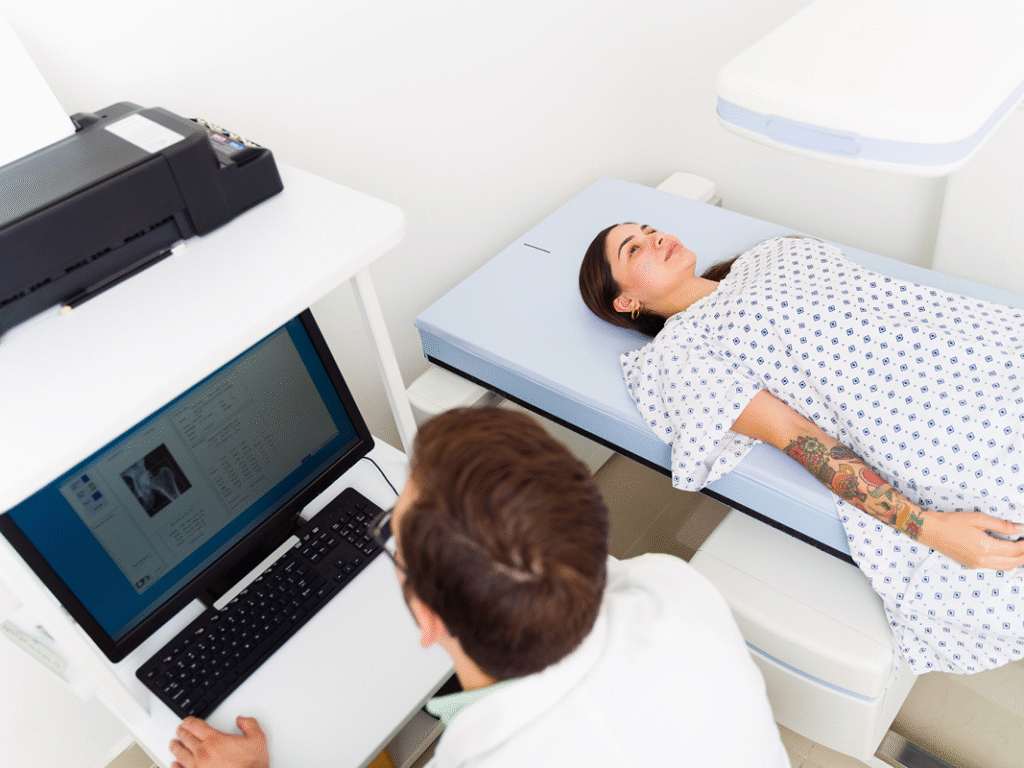
Maimonides Health Metabolic Bone Services brings together rheumatology and endocrinology specialists to identify and treat bone disease across its full spectrum—from age-related fragility to secondary and rare metabolic conditions. This interdisciplinary approach reflects the complex nature of bone health, where hormonal status, chronic and genetic disease, medication exposure, and systemic inflammation intersect.
“Our patients come from many different clinical pathways,” says Jocelyne Karam, MD, director of the Division of Endocrinology at Maimonides Health. “Primary care remains one of our largest referral sources, and we also see patients coming from OB/GYN, orthopedics, pulmonary medicine—any specialty that manages chronic diseases or prescribes steroids will see people who are at risk of fractures.”
The service helps ensure patients receive the right evaluation at the right time, especially those who need coordinated care across multiple divisions, including menopause care, which plays a central role in evaluating postmenopausal women with accelerated bone density loss.
“Our job is to make sure osteoporosis and other endocrine and metabolic bone diseases aren’t missed,” says Joshua Scheers-Masters, MD, director of Rheumatology Services at Maimonides Health. “That means tight collaboration among specialties and clear referral pathways for community clinicians.”
Endocrine and Metabolic Conditions
The metabolic bone team evaluates and manages a full range of common bone conditions, including:
- Osteoporosis, including postmenopausal osteoporosis
- Osteopenia and elevated fracture risk
- Age-related bone loss
- Fragility fractures
- Glucocorticoid-induced osteoporosis for patients on prednisone or other chronic steroids
- Vitamin D deficiency
- Metabolic abnormalities affecting bone remodeling
- Secondary bone loss related to chronic disease, including rheumatologic, endocrine, and gastrointestinal conditions
- Bone loss due to other hormonal therapies
These conditions often overlap with systemic disorders. “Hyperparathyroidism, thyroid disease, hypogonadism—all of these can present as bone disease,” Dr. Scheers-Masters says. “If clinicians don’t consider bone health when these diagnoses appear, patients can lose years of bone quality before we even see them.”
Care for Rare and Secondary Bone Diseases
Beyond common osteoporosis care, the program manages complex and rare metabolic bone disease that often require subspecialty interpretation and long-term follow-up:
- X-linked hypophosphatemia (XLH) – a hereditary disorder that causes low phosphate levels, leading to soft bones, impaired growth in children, bone pain, and early arthritis in adults
- Paget’s disease – a disorder where certain bones grow and break down too quickly, and the affected bone becomes enlarged, weaker, and more likely to fracture
- Osteomalacia – a condition where bones do not harden, usually because of low vitamin D or difficulty absorbing nutrients
- Bone disease associated with endocrine disorders – includes hyperthyroidism, hypogonadism, and Cushing syndrome, which can speed up bone loss
- Secondary osteoporosis – comes from another medical condition, such as menopause, endocrine abnormalities, long-term steroid use, or chronic inflammatory disease
“These conditions are less common and often underrecognized, but they carry big consequences,” Dr. Karam says. “We help interpret unusual symptoms, unexpected fractures, or abnormal laboratory results that point to a metabolic cause, and determine a course of treatment.”
Bone Health Diagnostics and Early Recognition
Early and precise diagnosis is essential to prevent fractures. “You cannot treat what you cannot see,” Dr. Scheers-Masters says. “And that starts with an accurate bone density (DXA) scan and a clinician who knows how to interpret it in the context of a patient’s hormones, medications, and metabolic profile.”
Bone density interpretation requires an understanding of fracture patterns, T-scores, Z-scores, and secondary contributors such as endocrine disease or medication-induced risk factors. Many patients are referred because their bone density loss or damage from an injury appears “out of proportion” to age or other risk factors, which requires a more thorough metabolic evaluation.
At Maimonides, Carl Schiff, MD, a rheumatologist who has led osteoporosis evaluation for decades, interprets bone density studies. “Dr. Schiff brings a level of consistency and accuracy that is hard to find,” Dr. Karam adds. “We rely on him because he knows how to evaluate the scan with an exceptional level of expertise, in the context of the whole patient.”
Operator-Dependent Challenges with DXA
DXA is highly operator-dependent, a point echoed by both Dr. Scheers-Masters and Dr. Karam and supported by theevidence-based literature. As one study1 noted, even slight differences in positioning or technique can significantly alter results.
“Not all DXA scans are created equal,” Dr. Scheers-Masters says. “The technologist’s technique matters, and the interpretation matters just as much.”
Incorrect positioning, incomplete regions of interest, and improper hip or spine alignment can change the diagnosis from normal to osteopenia—or from osteopenia to osteoporosis. “To ensure accuracy, Maimonides relies on standardized techniques and centralized interpretation by Dr. Schiff, whose scans are high quality, consistent, and reliable.”
Why Outside DXA Scans Often Need Repeat Imaging
“Our biggest challenge is when the patient comes with DXA scans that are hard to interpret,” Dr. Karam says. “Technical errors make them unreliable, and we sometimes need to repeat the scan at MMC to decide the correct course of therapy.”
Common concerns include:
- Physician interpretation lacking consideration of confounding factors—such as severe osteoarthritis, past fractures, or hardware—which can lead to overestimation of bone mineral density
- Images acquired on outmoded machines
- Incomplete or incorrect anatomical views
- Readings that do not include vertebral assessment
Because DXA quality varies enormously and positioning is inconsistent, it is important to compare DXA scans performed at the same center to track progression of the disease. DXA scans are conducted on site at Maimonides Doctors Multispecialty Pavilion on the main Maimonides campus, allowing patients to visit one convenient location for bone density testing, laboratory testing, and visits with endocrinologists, rheumatologists, and other specialists.
Interdisciplinary Care and Referral Pathways
Bone health sits at the intersection of multiple medical specialties, with patients served most effectively when primary care providers coordinate multidisciplinary care. Maimonides Metabolic Bone Services integrates:
- Endocrinology – for hormonal contributors such as thyroid disease, hypogonadism, hyperparathyroidism, Cushing syndrome, and menopause
- Rheumatology – for inflammatory and autoimmune diseases that accelerate bone loss
- OB/GYN and Menopause Center – for postmenopausal evaluation and estrogen-related bone decline
- Primary Care – for early identification of risk and labs that flag metabolic concerns
- Orthopedics and Spine Surgery – for evaluating bone strength before procedures and providing assessment and treatment for bone fractures
- Pulmonology, Gastroenterology, and Neurology – when chronic steroids or systemic disease affect bone health
- Physical Therapy – to help patients strengthen muscle mass and learn to safely practice weight-bearing exercises, which promote bone health and reduce risk of falls and injury
“Our program works because everyone touches bone health from a different angle,” Dr. Scheers-Masters says. “We close gaps between specialties, so patients don’t fall through them.”
First-Line Treatment and Advanced Care
Once a diagnosis is established, treatment often requires a combination of lifestyle interventions, targeted nutrient repletion, and medication. The therapy offered includes:
- Calcium and vitamin D optimization
- Weight-bearing and resistance exercise recommendations
- Antiresorptives (medications that slow bone loss)
- Anabolic agents promoting bone formation such as teriparatide and romosozumab in more severe cases
- Sequential therapy planning
- Monitoring for medication tolerance or contraindications
- Management of glucocorticoid-induced bone loss
- Therapy adjustments for endocrine disorders that alter bone turnover
“Medication choice is not one-size-fits-all,” Dr. Karam says. “Bone density, comorbidities, fracture patterns, and metabolic conditions guide what we select, how long we use it, and what we do afterward.”
Our on-site pharmacy at Maimonides Medical Center provides quick, simplified prescription fulfillment as well as over-the-counter medicines and supplements. In addition to easy links to specialty pharmacies around Brooklyn, this convenience helps patients get connected to needed interventions as soon as possible.
Guidance for Referring Providers
Early referral is critical, especially when systemic disease or medication exposure triggers bone loss. Refer a patient when:
- A DXA scan shows osteoporosis or osteopenia
- A fragility fracture occurs (hip, vertebra, wrist, or humerus)
- Rapid bone loss occurs without a clear explanation
- Hyperparathyroidism, thyroid disease, hypogonadism, or Cushing syndrome is diagnosed
- A patient requires long-term prednisone or other chronic steroid therapy
- Secondary bone disease is suspected
- Outside imaging is unclear, technically limited, or inconsistent
- Menopause-related bone loss accelerates
- Lab abnormalities suggest a metabolic or endocrine etiology
Advancing Through Clinical Innovation
Metabolic Bone Services continues to expand across Brooklyn with increasing collaboration, new imaging capacity, and emerging clinic locations.
“We are building a stronger pathway for referring clinicians,” Dr. Scheers-Masters says. “That means more access points, more reliable diagnostics, and a clinical model that brings every relevant specialty together.”
For patient convenience, Maimonides endocrinologists and rheumatology specialists practice at several Maimonides locations throughout Brooklyn, including the Maimonides Doctors Multispecialty Pavilion, Maimonides Doctors Clinton Hill Pavilion, and clinic offices in Bay Ridge and Park Slope. Starting in 2026, these services will also be available at a new Maimonides multispecialty center on Nostrand Avenue in Midwood.
“Patients feel the difference when we treat bone disease early and accurately,” Dr. Karam adds. “It prevents fractures and changes how they age and their quality of life.”
For more information on endocrine and metabolic services at Maimonides or to refer a patient, call 718-283-5923. For rheumatology services, call 718-283-8519. Both departments can guide patients through bone density testing and offer treatment for osteoporosis and metabolic bone diseases.
1: https://pmc.ncbi.nlm.nih.gov/articles/PMC11732917/#Sec27