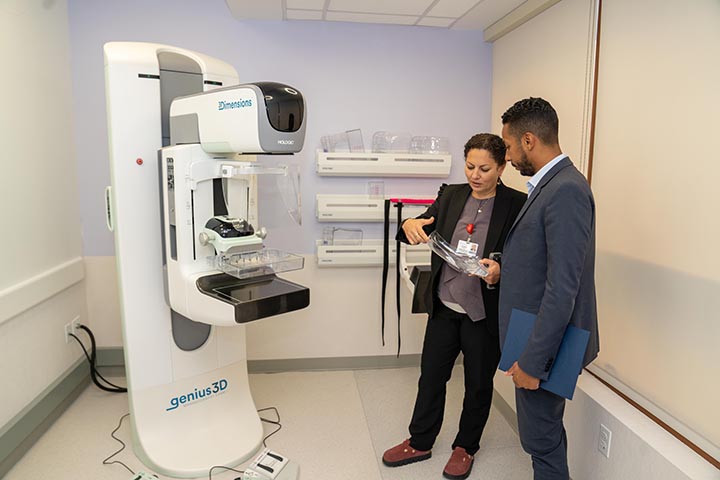
Since its establishment in 2011 as Brooklyn’s first fully accredited center for breast cancer care, the Maimonides Breast Center has remained committed to raising the bar for cancer care and screening. Last fall marked the completion of new renovations to the center’s lobby and patient waiting area; now, the center has opened its new, updated mammography screening suite, alongside a new Breast Cancer Survivorship Program that re-envisions long-term wellness for former breast cancer patients.
“Our new updates mark a more convenient, comfortable experience for all patients visiting our Breast Center, whether it be for routine screening, diagnosis, targeted treatments, or long-term care,” said Patrick Borgen, MD, Chair of Surgery for Maimonides Health and Director of Maimonides Breast Center. “We’ve tailored our care model to cater to the needs of these specific patient groups, giving each their own dedicated setting for care, led by highly experienced clinicians.”
Expanded screening, with a focus on identifying patients at high risk
Maimonides’ Erminia Rivera Breast Imaging Center of Excellence is the first and only Brooklyn-based program named as an American College of Radiology (ACR)–Designated Comprehensive Breast Imaging Center in multiple areas of breast cancer screening. The center is also certified by the National Accreditation Program for Breast Centers and the Quality Oncology Practice Initiative, and has earned the Outstanding Achievement Award from the Commission on Cancer of the American College of Surgeons. The opening of the new mammography screening suite, located on the second floor of the Breast Center, represents a critical step in expanding access to timely, high-quality breast care and breast imaging services.
“We are expanding screening services and increasing access in our own community,” said Jessica Torrente, MD, board-certified radiologist and fellowship-trained breast imaging specialist at Maimonides Breast Center. “We are offering lifesaving diagnostic care, including 3D mammography, breast ultrasound, and breast MRI, as well as the latest clinical AI-assisted tools. These allow us to provide the tailored medical care that our community deserves when it comes to breast cancer screening and prevention.”
With brand-new equipment, a mammography room, an ultrasound room, two changing rooms, and one bathroom, the modernized suite prioritizes patient comfort and ensures that the breast cancer screening process is as easy as possible. Expanded appointment availability on weekdays from 8:00 am to 6:00 pm makes scheduling easier—translating to greater access for patients in need of screening, with capacity for up to 45 patients per day.
A critical aspect of the center’s new process is the integrated risk assessment program, initiated during each patient’s appointment scheduling and discussed in depth during appointments. This tool assesses risk factors such as personal medical history, family history, age, ethnicity, lifestyle factors, genetic mutations, and detection of dense breast tissue to identify patients at high risk of developing breast cancer either in the next five years or over their lifetime.
Patients with a lifetime risk of developing breast cancer of 20% or higher are considered to be at high risk. While most mammography facilities do not assess lifetime risk, it is critical for patients and providers to be aware of because screening guidelines are different for high-risk women. High-risk patients can see MaryAnn Lopez, NP, Team Leader of the high-risk screening program, and receive imaging services within the same office on an expedited timeline.
Most mammograms in Brooklyn and elsewhere are read by general radiologists. At Maimonides, all patients’ mammograms are interpreted by a radiologist subspecialty-trained in breast imaging, such as Dr. Torrente.
“Informed by my years spent practicing in this field, I would recommend that every woman with the ability to do so—especially those at heightened risk—ensure that their breast cancer screening is conducted by a radiologist specifically trained to look for breast cancer,” said Dr. Torrente. “We are able to detect abnormalities at their earliest stages, understand the unique physiology of breast tissue to identify what generalists might miss, reduce the chance of false positive readings, and improve overall outcomes.”
Individualized Breast Cancer Survivorship Program
Maimonides’ Breast Cancer Survivorship Program caters specifically to patients previously diagnosed with breast cancer, who are five or more years past treatment.
“For many survivors, it can be hard to let go of seeing the clinical team they’ve trusted with their care in the toughest times, and having to re-explain the ins and outs of past disease and care plans poses significant challenges for both patients and providers,” said Dr. Torrente. “This program merges that all-important familiarity between care teams and patients with a focus on long-term wellness.”
Breast cancer survivors have different needs from women at the breast center for regular preventive and screening appointments. Patients have access to the most cutting-edge imaging equipment, without the exhaustion and anxiety of having to make sure their clinicians are aware of their personal health history. The program’s physicians, technicians, and staff know that each patient comes with their own story and unique health needs.
Primary care providers like Ina Ratner, MD, and benign breast/survivorship nurse practitioners including Noleen Lambert, NP, MSN, WHNP, and Angel Parmar, MSN, FNP, support the breast program and conduct clinical reviews with each patient as they transition into the survivorship program, conferring with surgeons, medical oncologists, radiologists, and other members of patients’ past care teams. Together, they help patients determine the best long-term plans for surveillance of possible recurrence, medication management, and multidisciplinary care for enduring complications, like lasting side effects, hormonal changes, pain, changes in bone health, sexual health and fertility problems, changes in mental and emotional health, and more.
“Our cancer survivors are an incredibly special group at Maimonides, and this program represents a new way to support them,” said Joshua Feinberg, MD, Chief of the Division of Breast Surgery at Maimonides. “For any issue a breast cancer survivor is experiencing, she has the confidence of knowing that it’s not our first time guiding a patient through the complexities of the healing process and incorporating cancer survivorship as a facet of long-term health. Breast cancer care is a multidisciplinary team approach. Our survivorship program bridges oncology and long-term healthcare, allowing patients to continue care with their existing providers while fostering seamless coordination among primary, specialty, and cancer care teams.”
Improved appointment wait times and fast-track care for suspected malignancies
Across the breast center, all patients benefit from improved appointment wait times, which have been reduced to one week, on average. Additionally, turnaround time for analyzing imaging results has also been shortened from 30 days to 10 days at maximum.
For any individual diagnosed with cancer, the Breast Center team contacts them immediately and fast-tracks next steps. Typically, initial appointments within five to seven business days are offered to any patient in need of continued care or additional diagnostics.
“We’re excited that this new phase of improved care is now underway, after working hard to redesign the flow of care to better serve our patients,” said Dr. Torrente. “These measures ensure we’re catching as many malignancies as possible in their earliest, most treatable stages, and help our patients feel safe and cared for through every step of our process, from their first mammogram to continued care as a cancer survivor.”
Learn more about the Maimonides Breast Center. To make an appointment or refer a patient, call 718-765-2550. Self-scheduling is available online and through the MaimoCare app.